
|
A traditional Jewish Wedding is full of
colorful rituals and joyous celebrations. Sometimes, the rituals may
vary according to the degree of orthodoxy but what remains the same
is their symbolic regard for the beauty and sanctity of the
relationship shared between husband and a wife.
Badeken - Unveiling of the Bride:
A Jewish bride enters the synagogue or the wedding venue on her
father's arm, whilst the third verse of psalm 100 is sung. Following
a tradition, especially amongst orthodox Jewish community, before
the ceremony begins the groom is led to the bride in order to check
that she is indeed his intended. The groom lowers his bride's
wedding veil to study her face. This wedding custom has its roots in
the biblical story of Jacob, who married the wrong woman when she
covered her face with a veil. Once the groom assures himself that
the right bride is standing beside him, the veil is let down over
her face and the ceremony proceeds. This custom, known as bedeken
usually takes place in a private room. The covering of the face
symbolizes the modesty, dignity and chastity that characterize the
virtue of Jewish womanhood.
Chupah or the Wedding Canopy:
Following a Jewish wedding custom, the bride and her family circle
the groom seven times after they arrive at the chuppah or the
wedding canopy. The circling of the bride denotes how central to her
life her husband is and it also represents a seven-fold bond which
marriage will establish between the bride and groom and their
families. The other meaning of the ritual is that just as the world
was created in seven days, the kallah (the bride) is figuratively
building the walls of the couple's new home. The number seven also
symbolizes the wholeness and completeness that they cannot attain
separately.
Blessings of Betrothal (Kiddushin): Two blessings follow the
events of the bridal procession. The first is said over a cup of red
wine, which is used on all festive Jewish occasions. The second
blessing gives thanks for the institution of marriage. The bride and
groom drink from the same cup to remind them that they will share
from the same cup of life, whatever it brings. Marriage, which is
called Kiddushin, is the sanctification of a man and woman to each
other. The couple makes solemn promises to each other and exchange
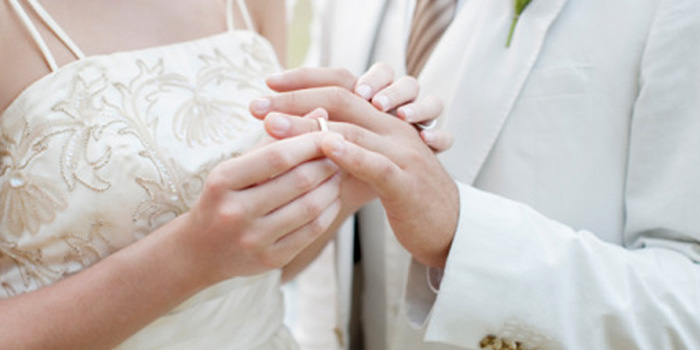
rings. Traditionally, the Jewish wedding ring must be a simple,
single band of metal. Wholeness of the ring symbolizes the union of
the couple. The Jewish wedding ring is placed symbolically on the
forefinger of the right hand following the belief that a vein runs
directly from this finger to the heart. By accepting a ring from
each other, the marriage is effected.
The Seven Blessings:
Following the Blessings of the Betrothal, the rabbi blesses the
couple by reciting Sheva Berachot or seven blessing. These blessings
acknowledge God as the creator of all human beings, and the joy of
marriage. Once again the bride and groom drink a cup of wine.
Breaking of the Glass:
After the blessings, the groom stamps on a glass as a part of the
tradition. The custom is intended to remind the Jewish people of the
destruction of the temple, the fragility of life and of the
inevitable mingling of joy and sadness. The breaking of the fragile
glass symbolizes the irrevocable and permanent lengths to which we
must all go to preserve intact our most significant relationship.
Once the glass has been broken, everyone shouts 'Mazeltov!'
Ketubah - The Jewish Wedding Contract:
This part of the ceremony involves the reading of the Jewish
marriage contract called the Ketubah. The contract outlines what
provisions the groom promised to make for his wife. It records the
marriage of the bride and groom and nowadays also affirms the mutual
love and support of the couple. The bride and groom now sign both
the Ketubah and the marriage register, confirming the absolute
validity of their marriage in both Jewish and English law. They sign
in front of the rabbi and two witnesses, who also sign.
Reception and Celebrations:
Jewish Wedding receptions are joyous celebrations, with much
singing and many traditional dances. A lively Israeli dance called
the Hora is traditionally performed at the wedding reception.
Another traditional dance performed on the occasion is called "gladdening
of the bride." All of the guests at the reception circle the
bride while they dance and sing praises about her. Of course, a
Jewish wedding would not be complete without a sumptuous meal to
satisfy the entire wedding party and guests. |