
Religion : Most Khasi are Presbyterian or Roman Catholic Christians. A small number of Khasis are Unitarian. Khasis also believe in nature worship.
Chief Deity : The main deity in the Khasi pantheon is the God simply referred to as U Blei ("the God"). Sometimes, this deity is seen as an androgynous being, and is referred to as U Blei-Ka Blei ("the God-Goddess").
Language : Khasi
Regional Spread : Meghalaya in India. Some Khasi reside in the hilly areas of Sylhet, Bangladesh.
Traditional Occupation : The Khasi tribes are usually dependent upon jhoom cultivation in which the vegetation is left to grow totally under the care of nature. In Bangladesh, one of the main products produced by the Khasi using jhoom cultivation is betel leaf.
Population : 879,000. Almost fifty percent of the population of Meghalaya.
Food Habits : The staple food of Khasi people is rice. Khasis also relish fish and meat. Like the other tribes in the North-East, the Khasis also ferment rice-beer, and make spirit out of rice or millets by distillation. Use of rice-beer is a must in ceremonial and religious occasion.
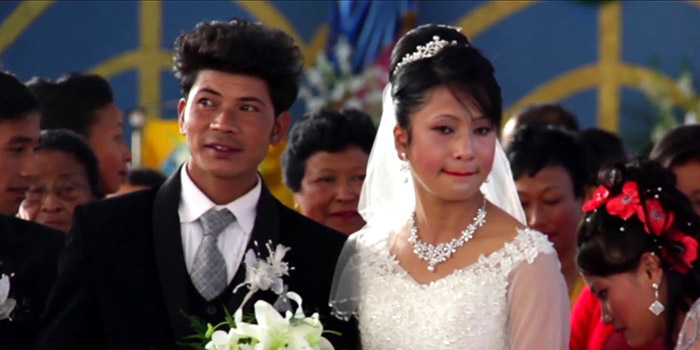
Marriage Preference : Marriage within a clan is a taboo in Khasis. Rings or betel-nut bags are exchanged between the bride and the bridegroom to complete the union. In the Christian families, however, marriage is purely a civil contract. There is no dowry system amongst the Khasis and both sexes are free to choose their own partners. Often there is no formal marriage ceremony with the relationship merely sealed by the man moving into a woman's joint family ancestral home.
The Khasi are a tribe in Meghalaya, India who call themselves Hynniew trep (which means "the seven huts" in the Khasi language). They comprise almost fifty percent of the population of Meghalaya, the remainder of whom are mostly Garo.
The Khasis inhabit the eastern part of Meghalaya, in the Khasi and Jaintia Hills.
The Khasi are of Mongolian stock and their speech has non-Khmer affinities and is connected with Cambodian. For centuries, they lived intact, preserving their system of beliefs. Khasi society is matrilineal, ie descent is through the mother. Traditionally, only women can inherit property or own land. As in many matrilineal societies, the maternal uncle is an extremely important figure in a child's life.