
Pronunciation : Brahmana
Religion : Hindu
Caste : Hindu Priestly Caste (regarded as the highest order caste)
Subdivisions in Brahmin Communities : Geographically, Brahmins are divided into two main groups - of the North and of the South. Each of these groups is further divided into five categories.
Categories of the North Brahmins : Kanyakubja, Sarasvata, Gauda, Mithila and Utkala.
Categories of the South Brahmins : Maharashtra, Telinga, Dravida, Karnataka and Malabar.
Presently there are 1,800 subdivisions in Brahmin Community. A Brahmin should be able to trace his origin to one of the seven great sages - Kashyapa, Atri, Bharadvaja, Gautama, Vishvamitra, Jamadagni and Vasishtha.
Major Brahmin Castes in India : Bardai Brahmins, Chitpavana Brahmins, Daivajna Brahmins, Deshastha Brahmins, Dhima Brahmins, Gouda Saraswat Brahmins, Havyaka Brahmins, Hoysala Karnataka Brahmins, Iyers, Kandavara Brahmins, Karade Brahmins, Karhada Brahmins, Kayastha Brahmins, Khandelwal Brahmins, Kota Brahmins, Konkanastha Brahmins, Koteshwara Brahmins, Nagar Brahmins, Namboothiri Brahmins, Niyogi Brahmins, Padia Brahmins, Rajapur Saraswat Brahmins, Saklapuri Brahmins, Sanketi Brahmins, Saraswat Brahmins, Shivalli Brahmins, Smarta Brahmins, Sthanika Brahmins, Thenkalai Iyengars, Tuluva Brahmins, Vadagalai Iyengars, Vaidiki Brahmins, Vaishnava Brahmins.
Language: Hindi
Regional Spread: Vedas
Traditional Occupation: Brahmins tend to engage in education and learning-based activities rather than purely business pursuits.
Population: Brahmins are said to be in minority in India. In 1931, Brahmins were 4.32% of the total population. Their maximum population is in Uttar Pradesh (9%), while in Tamil Nadu they form 3% and in Andhra Pradesh about 2% of the population.
Food Habits : Culturally, most Brahmins are known for practicing strict vegetarianism. Some are not even allowed to eat onions, garlic, mushrooms and some other foods.
Marriage Preference : Prefer intra-caste marriages
Famous Personalities : Bal Gangadhar Tilak, K.B. Hedgewar, Vinayak Damodar, Savarkar, Nathuram Godse, Sarvepalli Radhakrishnan, Jawaharlal Nehru, Sir M. Vishveshwaraiya, Sri Thyagaraja, N R Narayana Murthy, chairman of Infosys Technologies Ltd
The word 'Arora' is derived from a place name, Aror (now known as Rohri, in Sind, Pakistan). According to legend the Aroras are of Kshatriya stock, but denied their Kshatriya origin in order to escape persecution by Parashuram (paraurama in Sanskrit means 'Rama with the axe'), calling themselves Aur, which means 'someone else' in Hindi and Panjabi.
Meaning of the word 'Brahmin' : The word Brahmin is said to literally mean, "One who has realized or attempts to realize Brahman." The traditional duties of this caste include studying Vedas, preserving them in memory and transmitting them orally to the next generation. Brahmins were also the philosophers, contributing to Hindu Philosophy and religion. The priests of Hindu temples were also from this caste. In ancient India, Brahmins also served as spiritual advisors to Kshatriya kings.
History and Origin : According to the Puranas, Brahmins were created from the mouth of Brahma so that they might instruct mankind. Because of this reason they were considered the highest of the four castes.
According to the Aryan invasion theory, Brahmins are descendants of the Aryans, who displaced the Dravidians from the northern areas of India. The religion practiced by the early Aryans derived from the Vedas and what scholars know as Brahminism laid part of the societal foundation for Classical Hinduism as witnessed with the advent of the Upanishads, the Ramayana and Mahabharata.
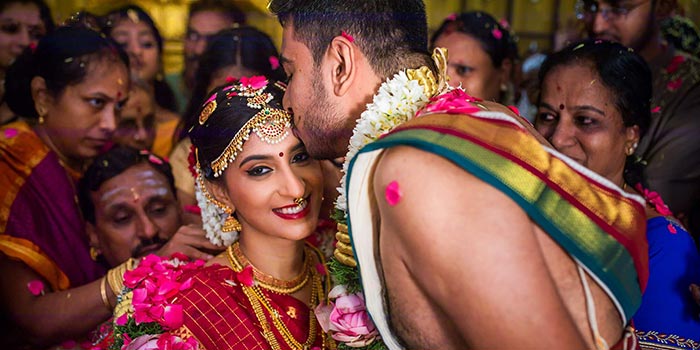
Brahmin Culture :Brahmins have specific rituals for marriage, conception and consummation of the wedding. Besides, there are rituals for childbirth, naming ceremony, first feeding ceremony, child's first tonsure (mundan), upanayana (the sacred-thread ceremony - initiation into vedic learning and ritual), ritual baths, cremation rituals, shraaddh, etc. All of these rituals are very important for a practicing Brahmin. People of Brahmin Community also give lot of importance to purity of body and mind and hence attach great importance to ritual baths and cleanliness.