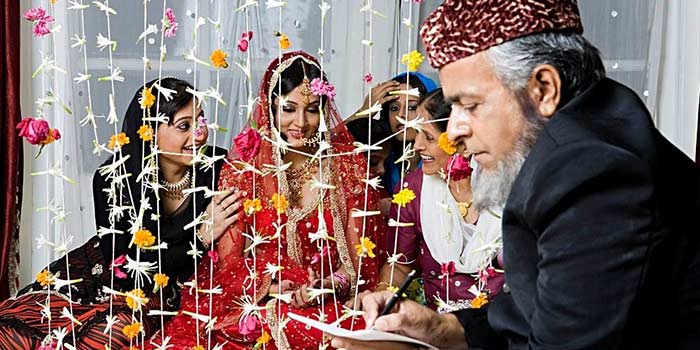
Muslim Wedding or Nikah is celebrated on a grand scale for a period of five-days. Muslim wedding can be conducted at any convenient time, as there is no concept of auspicious time. The Nikah ceremony can take place either at the bride or bridegroom's residence or at a place that is convenient for both parties. Just as in any other Indian wedding, here too marriage ceremonies can be divided into pre-wedding, wedding and post-wedding celebrations.
Pre-Wedding Rituals
Here is a short description of the pre-wedding rituals followed in a typical Muslim Nikah.
- - Legan Chir :When the date of marriage is finalized, cash present is sent to the bride's father by the groom's father. The ceremony is known as Legan Chir.
- - Day 1 and Day 2 Ceremonies : On days one and two, first the bride's people and then the groom's, go to the other party's house, carrying mehendi paste in a plate. The children carry candles, which are lit before entering the respective houses. Dinner is served and songs teasing both the boy and girl are sung.
- - Manjha Ceremony : On the third day, manjha ceremony takes place. The prospective bride is seated on a small square table and anointed with haldi (turmeric) provided by the boy's family. Following this ceremony, a married friend will accompany the bride everywhere and at all times. This friend will also spread the turmeric over the bride's whole body before she bathes. For this ceremony the bride is supposed to wear yellow clothes and no jewelry. There is, again, much celebration and singing.
- - Mehndi Ceremony : The Mehndi ceremony is held at the home of the bride on the eve of the wedding ceremony or a couple of days before it. Following the tradition, the female relatives of the bride anoint her with turmeric paste to bring out the glow in her complexion. A relative or a mehndiwali applies mehndi on the hands and feet of the bride. The event has a festive feel to it with the women singing traditional songs. The bride wears sober clothes on the day. According to custom the bride must not step out of the house for the next few days until her marriage. The bride's cousins sometimes apply a dot of mehndi on the palm of the groom.
Wedding Rituals
Muslims observe a unique set of rituals at the time of their wedding. Please read on to find out how Muslim Nikah is conducted.
- - Welcoming the Baraat : The groom arrives at the wedding venue with a wedding procession or baraat consisting of relatives and friends. A band of musicians strike up some traditional notes to announce their arrival. The groom shares a drink of sherbet with the bride's brother. The bride's sisters play pranks and slap the guests playfully with batons made of flowers.
- - Nikaah: It is on day four the actual Muslim Nikaah or wedding ceremony takes place. Nikah can be conducted at the home of the bride or the groom, or at any other convenient venue. The nikaah ceremony is presided over by the qazi or law officer. The qazi appoints two men as witnesses (Gawah) on the groom's behalf, to receive orders for the nikah from the bride's family. In addition to the presence of two witnesses, the presence of the two 'Walis' (the bride's and the bridegroom's father) is also necessary. The bride's father is required to care for and protect her rights and the groom's father to endorse his rights.
In orthodox Muslim communities, the men and women are seated separately in Zenana (for woman) and Mardaana (for men). The Maulvi reads selected verses from the Quran and the Nikaah is complete after the Ijab-e-Qubul (proposal and acceptance). The validity of the Nikaah depends on proposal on one side, usually the groom's (Ijab) and acceptance on the other side, the bride's (Qubul). The mutual consent of the bride and groom is of great importance for the marriage to be legal. Besides, the Islam marriage law demands that neither of the parties must be legally incapacitated from entering into the marriage.
On the day of the Nikaah the elder members of the two families decide the amount of Mehar (nuptial gift). In Muslim Nikah, Mehar is a compulsory amount of money given by the groom's family to the bride. The qazi personally asks the bride if she has agreed to marry the groom and whether she accepts the quantum of mehar. Once the bride gives her consent the qazi reads the marriage contract to the groom. After the groom gives his consent, the Nikaah-Nama or marriage contract must be signed by the bride, the bridegroom, their Walis, the witnesses and the Qazi. The Nikaah-Nama also contains certain terms and conditions, which are in accordance with the religion and agreeable to both parties. A noteworthy condition is that in case of a disagreement between the two partners, the girl has a right to divorce her husband.
After the Nikaah-Nama is signed, the Qazi delivers a sermon called Khutba, consisting of verses from the Quran which were recited by the prophet and which lay particular emphasis on obligations toward women. The Qazi explains the meaning of these verses to the audience with an explanation of the mutual rights and duties of the spouses.
- - Blessing the Groom : After the wedding ceremonies are over the groom receives blessings from the older women and offers them his salaam. The guests pray for the marital bliss of the newly wed couple.
- - Dinner, Prayers and Aarsimashaf :Dinner is a lavish spread. Usually, the women and the men dine separately. After dinner, the newly-weds sits together for the first time. Their heads are covered by a dupatta while they read prayers under the direction of the maulvi (priest). The Quran is placed between the couple and they are allowed to see each only through mirrors.
Post-Wedding Rituals
Post-Wedding rituals followed in Muslim Nikah are similar to what we see in other Indian weddings. However, here the customs are followed under different names and some cultural variations can be observed.
- - Ruksat : The bride's family bids her a tearful farewell before she departs for her husband's house. The bride's father gives her hand to her husband and tells him to take protect and take good care of her.
- - Welcoming the Bride : At the groom's house, the groom's mother holds the Islamic Holy book Quran above the head of her newly wed daughter-in-law as she enters her new home for the first time.
- - Chauthi : The Chauthi is the fourth day after the wedding. It is customary for the bride to visit the home of her parents on this day. The bride receives a joyous welcome on this day.
- - Valimah : The Valimah is the lavish reception that the groom's family hosts after the Nikaah. It is a joyous occasion that brings together the two families, their relatives and friends.