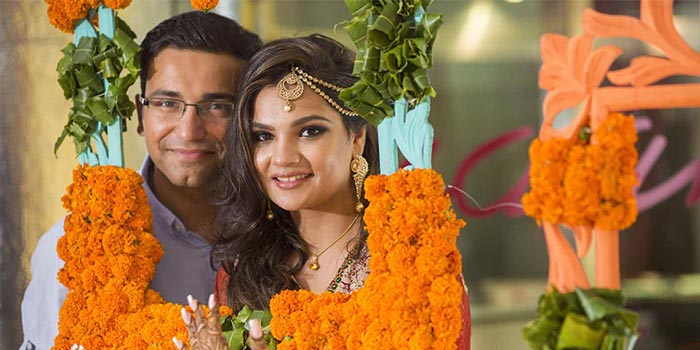
Traditional Sindhi wedding is a lavish affair and is full of traditions and colorful customs. Sindhis go in for arranged marriages and take help of the third party negotiations. Utmost care is taken to match the status of the two families. A priest decides date of the wedding after matching the horoscopes of the prospective bride and the groom. In a number of cases, when the auspicious time to get married cannot be fixed astronomically, a Gudhuro marriage is performed, which can be performed on any day after sunset. Given here is a description of the essential features of a typical Sindhi Wedding ceremony.
Pre-Wedding
Some very unique and interesting pre-wedding customs are followed in a Sindhi wedding.
- - Kuchcha Shagun or Kachchi Misri:Kachchi Misri is the first formal ceremony that takes place after both the families approve of the match. In this, the girl/boy is given mishri and coconut to signify that she/he is the one who belongs to the other family. This is called Kuchcha Shagun or Kachchi Misri.
- - Pakki Mishri: : Pakki Mishri or the formal engagement ceremony takes place a week before the wedding. In this ceremony, the boy and the girl exchange rings. A get together of family members and close friends is also organized to mark the joyous occasion.
- - Dev Bithana : This ceremony is takes place a few days prior to the wedding and is the starting point of the wedding celebrations. A priest installs a chakki (stone grinder) as a totemic deity, which is worshipped till the end of marriage ceremonies. Dev Bithana takes place separately in the houses of the bride and the groom. Dev Bithana marks the beginning of the period during which the neither bride not and the groom is allowed to leave his/her house. Ainars (marriage guards) look after the requirements of the bride and the groom and assist them at every step till the marriage is over. The brothers- in-law of the groom and the bride are, respectively, appointed as Ainars.
- - Lada : Lada marks the beginning of marriage preparations in the groom's house. The groom's family holds a ceremonial singing session of traditional wedding songs. Ladas are sung to the beat of a dholak (drum) or a plain thaali (metal plate). The family of the groom invites the neighborhood women to participate in the function. There is a lot of dancing also.
- - Berana : Berana is a satsang that is organized in the name of the Sindhi God, Jhulelal ten days before the wedding. Berana signifies the start of the ceremonies for the forthcoming wedding.
- - Mehendi: In a Mehendi ceremony, the girl's hands and feet are adorned with artistic mehendi patterns. At this time the women in the family get together, play music. Folk songs are also sung on this day. On this day is the Wanwas. In this the girl and the boy are asked to wear their old clothes, which are torn and discarded once the ceremony is over. These clothes are then wrapped into a bag and thrown into the sea/river. This is symbolic of doing away with the old for bringing in the new and warding off evil.
- - Santh : In a 'Santh' ceremony seven married women put oil on the girl's head. It is performed the night before the wedding. The bride is then asked to break the cover of an earthen pot placed before her in a go. If she succeeds, it is considered to be a good sign. This ceremony is also performed on the groom at his place.
- - Ladies Sangeet Party : Like the bachelor party hosted by the groom's side there is a party which the bride gives her girlfriends as a maiden called the ladies sangeet. In this womenfolk regale themselves by singing tradition wedding songs and dancing on them.
- - Saagri The Saagri or the ceremony of showering of the bride with flowers is performed on the same evening. The groom's married sisters, cousins and the small children from his side go to the bride's place with the jewelry made of mogra. The sisters dress the bride in a silk saree and then adorn her with the flower jewelry. Later, in the night, the groom visits the bride's house where he is showered with garlands. A feast is held for the family. This ceremony signifies the blessings, which are showered on the bride in the form of flowers.
- - Ghari Puja : This interesting ceremony is carried out in the respective homes of the bride and the groom. The priest performs the prayers and married ladies grind wheat on a small old-fashioned grinder symbolizing that the home will always be prosperous. The groom offers a handful of grains to the priest indicating he will always give to charity and look after those less fortunate. The mothers of both the bride and groom dress up in their bridal finery. Carrying an earthen pot of water on their heads, they walk to the threshold of their homes. The sons-in-law of the respective families cut the water with a knife to ward off any evil spirits. Friends and relatives adorn the parents with garlands of flowers and money.
- - Baraat : As is customary in Hindu marriages, the groom wears a sehra or a crown and then sits on the mare. The groom's mother holds the lamp lit for the household deity. Amidst singing of ceremonial wedding songs, the womenfolk make oblations of grain to the crown. A band of musicians accompanies the baraat amidst singing and dancing.
- - Swaagat : When the baraat reaches the wedding venue, the family of the bride welcomes the groom's procession with garlands. At this point, the bride is taken onto the terrace or a window from where she gazes upon the groom's mukut (crown) but not on his face. The sisters and brothers of the bride ask the groom to come inside. The women are welcomed with sindur (vermilion). Their married or suhagin status is honored with red ribbons or scarves. The bride's family also gives them gifts, which is usually a sari.
Wedding Rituals
Given here is a brief description of the Singhi Wedding rituals.
- - Paon Dhulai : This custom is peculiar to Sindhi Wedding. In this the couple is seated with a screen separating them and thus cannot see each other. The brother of the bride then washes the feet of the bride and the groom in a bronze thaali with raw milk. The priest measures the feet of both the groom and the bride with a thread kept by the bride.
- - Jaimala : Then comes Jaimala where the bride and the groom face each other and exchange garlands.
- - Hathialo : In this unique ceremony, the corner of the bride's sari is tied to a scarf, which is worn by the groom. The right hands of the couple are tied with a thread that has been blessed with religious incantations. The tying of the hands signifies an eternal bond that will join them forever. The couple then prays to the Gods to give them strength and bless their union.
- - The Wedding Ceremony : The wedding ceremony is performed by the priest in the presence of family and friends. The bride and groom are seated in front of a holy fire and the priest recites various religious sayings from the Holy scriptures. The couple walks around the fire four times, exchanging vows of duty and love, fidelity, respect and a fruitful union. The groom then places the brides hand on his forehead, to denote that he accepts her as his wife for better of for worse, in health or in sickness and that it his destiny to marry her.
- - Kanya Daan : Just as is the custom in other Hindu marriages, the bride's parents entrust their daughter in the safe keeping of the groom and his family. This is followed by Vidai ceremony, when the bride leaves her parents house and move towards the groom's house. In Sindhis, the bride and the groom travel separately on different routes.
Post-Wedding Rituals
Following are the post-wedding rituals of a traditional Sindhi Wedding.
- - Datar - Welcome for the Bride at her new house : The arrival of the bride and the groom is announced by loud beating of drums. At the entrance of their new home the bride's feet are rinsed by the groom's parents. A cover is placed over her head as she sprinkles milk in all corners of the house. The bride picks up a handful of salt and places it in the hands of her husband. He passes it back into her hands without spilling any salt, this is done three times. Similarly, the "datar" is carried out with all members of the groom's family. Exchanging salt symbolizes that just as salt blends in and gives taste to food, so must the bride blend in and become a part of her new family.
- - Chhanar : The marriage is finally considered concluded with Chhanar - the removal of the Devs (chakki installed as a totemic deity). This is also known as Dev Uthana.
- - Sataurah : Following the tradition, the bride and the groom go to the bride's house at an auspicious time fixed by the priest.