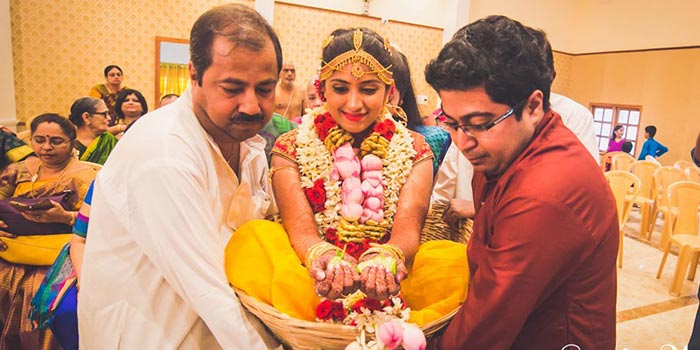
Telegu Wedding is an elaborate affair and comprises of a large number of rituals and ceremonies that spread over several days. It may be noted that there may be certain regional and caste variations regarding ceremonies related to Telegu wedding ceremony. However, what remains essentially the same is the highest regard of Telegu people for the institution of marriage.
Pre-Wedding Rituals
Here is a short description of some of the popular pre-wedding rituals of a Telegu marriage ceremony.
- - Muhurtam :Muhurtam means determining the auspicious part of the day for the marriage. The period that is considered auspicious starts from 7.00 p.m. and goes on till the next day until about 11 am. Telegu Weddings don't usually take place in the months of Aashad, Bhadrapad and Shunya as these months are considered not auspicious.
- - Pendlikoothuru : This ceremony involves anointing the bride and the groom with oil and turmeric before bath. Following the bath, the couple don new clothes. The bride-to-be wears flowers in her hair. She also adorns her forehead with a bindi or vermilion dot and wears bangles on her wrists.
- - Snathakam : Snathakam ceremony is performed at the bridegroom's house before the muhurtam. It is a sort of thread ceremony that involves making the groom wear a silver thread on his body.
- - Kashi Yatra : This is an extremely joyful ceremony. Following the tradition, after the recitation of Vedic verses, the groom pretends to leave for Kashi, a pilgrimage center to become an ascetic. He carries a walking stick and other essentials to show that he is not interested in becoming a householder anymore. He relents and agrees to the marriage only after he is stopped and persuaded by the bride's brother to fulfill his responsibilities as a householder.
- - Mangala Snaanam : Following the custom, the bride and groom must take a Mangala Snaanam or an auspicious bath on the day of the wedding. The bath is believed to cleanse and purify them and make them ready for the sacred rites that are to follow.
- - Aarti : After the ceremonial bath, the bride and groom are anointed with oil at their respective homes. Their families perform aarti. The ceremony is significant as it carries with it the family's prayer that the mind of the bride/groom be illuminated by wisdom.
- - Ganesh and Gauri Pooja : The bridegroom performs Ganesh pooja in the mandapam or wedding hall just before the marriage ceremony. Worshipping the revered Ganesha who is the remover of all obstacles. Similarly, the bride performs Gauri Puja and seeks blessings for a blissful married life.
Wedding Rituals
A typical Telegu Wedding is full of joyous and colorful rituals. Please read on to know more about Telegu Wedding traditions.
- - Kanyadaan : A significant part of Hindu weddings, the Kanayadaan is that part of the marriage ceremony in which the girl's family gives her away to the groom. In a traditional Telegu wedding, bride's maternal uncle carries her in a bamboo basket to the mandapam where a curtain separates the bride and bridegroom. They are not to see each other until after the marriage ceremony. The priest invokes the blessings of the ancestors belonging to the last seven generations of both families. The bride's parents wash the groom's feet in a gesture that symbolizes their belief that he is a form of God to whom they now offer their daughter's hand.
- - Jeelakarra Bellamu : After the priest recites the wedding shlokas from the Vedas, the bride and groom apply a paste of cumin seeds (jeera) and jaggery on each other's hands. This is known as Jeelakarra-Bellamu. This slightly bitter cumin and sweet jaggery when ground together turn into an inseparable mixture. The custom signifies that bride and groom are supposed to become inseparable through life's bitter and sweet times.
- - Madhuparkam : For the Madhuparkam ceremony the bride wears a white cotton sari with a red border, while the groom dons a white cotton dhoti with a red border. White signifies purity and chastity, while red color represents strength.
- - Sumangli : Under this ceremony, ten married women (Sumangalis) accompany the bride. Six of them hold plates full of rice and turmeric powder mixed together. The remaining hold plates with small lamps made from a mixture of rice flour, sugar and milk. Rice signifies abundance while lit lamps represent sweetness and light, two qualities that the bride brings with her to this new phase of life.
- - Tying of the Mangalsutra : To carry out this ritual, the curtain between the bride and the groom is removed. After offering prayers, the groom ties the two strings each with a golden disc representing the Mangalsutra separately around the bride's neck with three knots to represent the strength of their union physical, mental and spiritual.
- - Kanyadaan Akshata : After the mangalsutra ceremony, the couple exchange garlands. Those present at the wedding shower their blessings on the couple by sprinkling flowers and turmeric-colored rice or Akshat on them.
- - Saptapadi : 'Saptapadi' or seven steps are what the couple takes together. In this ceremony the bride's saree and the groom's dhoti are tied together at one end in a knot. In each step that he takes, the groom prays for life-long blessings. During this ceremony, saris, ornaments and other gifts are offered to the couple and to other family members.
- - Sthaalipaakam : In this sweet ceremony, the groom slips silver toe rings on the bride's feet. The girl is also adorned with a string of black beads, to protect her from the evil eye.
Post-Wedding Rituals
Given here is a short description of some prominent post-wedding rituals of a traditional Telegu Wedding.
- - Grihapravesh : When the marriage ceremony is over the bride is ceremonially taken to the groom's home for Griha Pravesh (entering the house for the first time). Here, the in-laws give the bride a warm welcome.
- - Uniting the Mangalsutra : As is customary in a Telegu wedding, the two mangalsutras are united on a common thread 16 days after the wedding. An elder member of the family or the husband himself can unite the two mangalsutras on a common thread. A few black or golden beads are slipped between the two plates so that they don't clash with each other. Signifying harmony between the two families. The bride takes a bath and wears a new sari before wearing the mangalsutra on this day. 16 days are symbolic of the time needed by the bride to understand her husband's family.