
Bahai ReligionThe Baha'a Faith is the youngest of the world's independent religions. The central theme of Baha'a is that humanity is one single race and that the day has come for its unification in one global society. The worldwide community of five million Baha'as represent a large number of nations, races and cultures.
The religious matrix of Baha'a Faith was Islam but it is entirely different from its parent religion. Baha'a Faith first appeared in Persia and later spread to neighboring Muslim lands in Ottoman and Russian Empires and northern India. Since most of its followers are from Islam, a lot of its religious ideas are drawn from Quran. but, Baha'a Faith differs mainly from its parent religion in that it accepts the validity of other great faiths.
Born in 1817 in Persia, Baha'u'llah is considered to be the founder of Baha'a Faith. Baha'u'llah was endowed with wealth and vast estates but he turned his back to the position of the court and was known for his generosity and was deeply loved by his countrymen.
Baha'u'llah suffered loss of worldly endowments in a series of violence unleashed upon Babis for his apparent support for the message of Bab. After the execution of Bab he was subjected to imprisonment in Baghdad where he announced himself as the One promised by the Bab. Baha'u'llah passed away in 1892, at Bahja, just north of Acre, and is buried there.
The Baha'a faith believes in the fact that each human being is a "mine rich in gems" and inexhaustible in its wealth. It says that the purpose of life is to develop these capacities for the one's own good and for service to humanity.
It encourages personal development and advocates daily prayers and meditation. It proscribes the use of alcohol and drugs and lays great importance to the institution of the family as the foundation of human life.
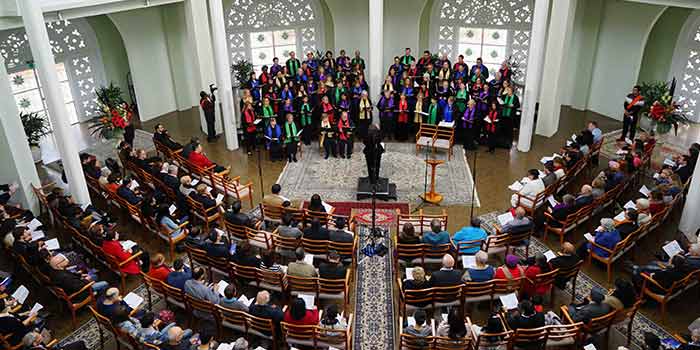
The Baha'as have created a new calendar which begins on March 21, at the spring equinox. Their Houses of Worship are open to all. Their architectural styles are unique. Nine sides and central dome are common to all of them which symbolizes diversity of human race and its essential oneness.
Baha'a scripture comprises the writings of the Bab and Baha'u'llah, together with the writings of 'Abdu'l-Baha. Among the better known writings of Baha'u'llah are, The Most Holy Book, The Book of Certitude, Gleanings from the Writings of Baha'u'llah, The Hidden Words and The Seven Valleys. Its scriptures have been translated into 800 different languages.
The Baha'as have created a new calendar. Its year begins on March 21, at the spring equinox. Other fixed seasonal days of celebration or commemoration are :