
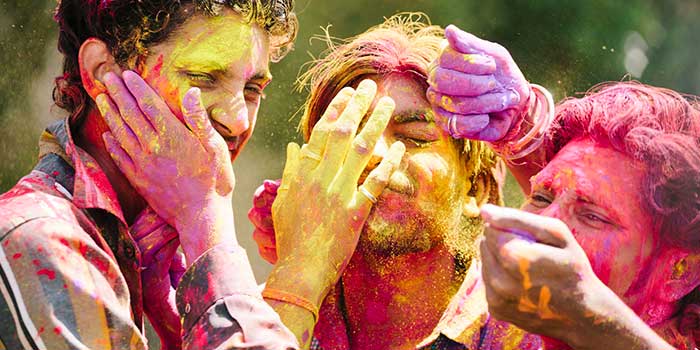
A festival of colors and joy the celebration of one of the most awaited Hindu festival of the year Holi is on 29th of March 2021. The colorful spring festival is celebrated on the full moon day that is in the month of Phalugna or Falguna .
The festival of Holi is a great time when all of families and friends get together and it can be said very simply that the fragrance of the colorful Holi symbolizes your love for every one else . The festival of Holi is a time when all disputes and fights get dissolved in love and joy to celebrate the festival and that results in strengthening the felling of oneness and love .
Legend has it that there was a demon king by the name of Hirnakashyip who ruled Earth. He got so carried away by his mighty powers that he started thinking of himself as a superior being to Lord Vishnu. He had announce in his kingdom that he will not allow anyone worship Lord Vishnu and any found in violation of this rule would be prosecuted. Rebellion to this rule was born closer inside home and took the king by surprise. It was his son, Prahlad who openly defied the order of his father and continued worshiping Lord Vishnu. Infuriated by the defiance put across by his son, Hirnakashyip ordered his soldiers to throw his son down a hill. Not deterred by this, Bhakta Prahlad continued his devotion towards Lord Vishnu and rewarding him for his devotion Lord Vishnu rescued the boy from the evil hands of his fathers and saved his life.
Hirnakashyip got very irritated and angry at Lord Vishnu's intervention and summoned his sister Holika to eliminate his son who had a boon that she could walk through a fire unharmed. Holika entered fire with Bhakta Prahlad in order to finish him off inside the fire. However, Holika was the one who got burnt in the process as the boon was for her to enter the fire alone and Bhakta Prahlad was saved by Lord Vishnu once again.
Holi derived from Holika is therefore celebrated with lot of jubilation to symbolise this victory of good over evil.
The festival offers some very common drinks like Thandai and Bhang and sweets like Gujiyas are consumed almost every where other famous foods you can expect in Holi is kanji-ke-bare it is thin lentil patties and small pooris also called as Papri.
The Festival is belived to have its roots in Vrindavan, Mathura and other places associated with Lord Krishna where the festival begins nearly a fortnight early and it goes on till the day of holi. Allfamily members get together and a little bit of gulal is sprinkled over the eldest member of the family.
Uttar Pradesh is the best place in India to experience the true flavor of the festival of colors Holi. Celebrations in Mathura and Varanasi are the most exciting amongst all of the celebrations in the state. The essence of Holi celebrations in Brajbhoomi is said to be kept the same even today, as it was celebrated thousands years back (during Krishna's era). Holi in Braj start a week earlier than the rest of India. The concept of the Holi at Braj is that men from Nandagaon (Village of Lord Krishna) raid Barsana (Radha's village) to raise a flag on Shri Radhikaji temple. The catch being that women from Barsana greet them with long wooden sticks and colored water where the men have to be well padded as they cannot retaliate. Their only self-defence is water guns which they use at the ladies in order to distract them. This is one of the most popular of the Holi festivals in India also popularly called as 'Lathmaar Holi'.
Holi is one beautiful and colorful festivals of India. This is one festival where all the religious, linguistic and cultural barriers are broken. To feel the real essence of Holi, it must be witnessed in the spirits of men, women and children of Uttar Pradesh.
"Syama piya more rangade chunariya
Aisi rangade ke ranga nahi chhute
Dhobiya dhoye chahe yeh sari umaria
Lal na rangaun main, hari na rangaun
Apane hi ranga mein rangade chunariya
Bina rangaye main to ghar nahi jaungi
Beet hi jaye chahe yeh sari umariya
Jal se patala kaun hai
Kaun bhumi se bhari
Kaun agana se tej hai
Kaun kajala se kari
Jala se patala jnana hai
Aur pap bhumi se bhari
Krodha agana se teja hai
Aur ik kalana kajala se kari
Mira ke prabhu giridhara nagara
Prabhu charanana mein
Hari charanana mein
Syama charanana mein lagi najaria "
"Rang barse bheege chunar wali, rang barse
Are kaine maari pichkaari tori bheegi angiya
O rangrasia rangrasia, ho
Rang barse bheege chunar wali, rang barse ...
Sone ki thaali main jona parosa
Are, sone ki thaali main jona parosa
Haan, sone ki thaali main jona parosa
Are, khaye gauri ka yaar balam tarse rang barse
Holi hai!!!
O, Rang barse bheege chunar wali, rang barse ...
Launga ilaichi ka, are launga ilaichi ka
Launga ilaichi ka? Haan
Are launga ilaichi ka beeda lagaya
Haan, launga ilaichi ka beeda lagaya
Chabe gauri ka yaar, balam tarse
Holi hai!!!
O, Rang barse bheege chunar wali, rang barse ."