
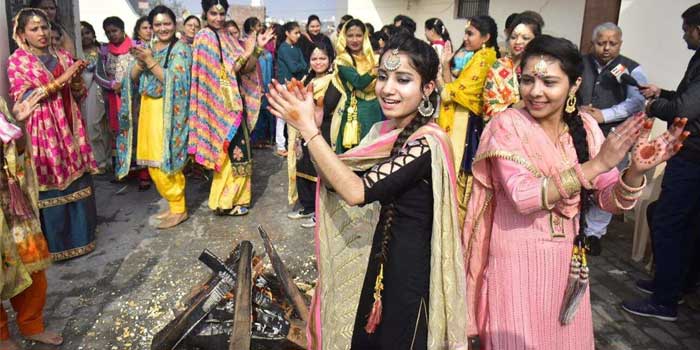
Celebrate Lohri on 13 January
Lohri is an auspicious Occasions that is celebrated as the harvest festival of Punjab- a North Indian state also called the breadbasket state of India. Lohri is celebrated with great joy and fervor specially among the farmers fraternity as this festival is associated with the harvesting of the Rabi (winter) crops. The festival of Lohri is an Occasions that urges people to extend their thankfulness and prayers to the God for being so kind and bringing prosperity for all. Lohri is celebrated by Sikhs & Hindus alike, in the North Indian states of Punjab, Haryana, Delhi and parts of Himachal Pradesh.
As a harvest festival, Lohri is marked during the month of January in which the farm fields portray the shining crop of wheat- the main winter crop in North India. Lohri is enjoyed between the harvesting and sowing of this winter crop, with lots of joy by family, friends, singing, dancing on folk songs around the bonfire in the evening. The festival of Lohri is considered an auspicious Occasions for celebrating the birth of babies and the arrival of newly wed bride to the family.
Lohri, as per the Hindu Calendar, falls in the month of Pausha or Magha generally on 13th January, a day before Makar Sankranti. After the day of Lohri the earth starts its journey towards the Sun thus calling the end of winter season and onset of summer season.
According to the historical and mythological references the term its origin from 'Loi' the wife of Saint Kabir. Although in Punjab Lohri is known as Lohi while other believe that the festival has got its name from the term 'Loh' that means iron. The celebrations Lohri festival has eating of til (sesame seeds) and rorhi (jaggery), therefore it is believed that made the term 'Tilorhi' that suppressed in the Lohri.
The tale of Dulla Bhatti is the most recognized origin of Lohri. Dullha Bhatti is an icon figure of Punjabis and is associated with the celebrations of Lohri- the harvest festival of India. Dulha Bhatti was a muslim highway robber who used to rob people and would save the Hindu girls being taken for selling the slaves market. Then he used to arrange the marriage of those rescued girls with Hindu boys with all rituals and even arranging the dowry of money and material. Due to these social services, Dulla Bhatti became a legendary figure among the Punjabis. On the eve of Lohri festival the folk songs praising the heroic character of Dulha Bhatti are sung.
Lohri is celebrated in various parts of India but in different ways- Pongal in Tamil Nadu, Bihu in Assam, Bhogi in Andhra Pradesh and the Sankranti in Karnataka, Bihar and Uttar Pradesh. The main attraction of Lohri festival is the traditional bonfire celebration. In the evening all family members light the up the bonfire and dance on the Lohri folk songs with great enthusiasm. A puja is also held with a prayer to Agni, involving parikrama around the fire for abundant crops and prosperity. Also makki ki roti and sarson ka saag composes the dinner and til, gazak, gur, moongphali, phuliya comprises the prasad. On Lohri, womenfolk and children get attention. For a bride, the first Lohri is extremely important. Children sing and dance asking for the Lohri prasad.
The 'ho's are in chorus
Sunder mundriye ho!
Tera kaun vicaharaa ho!
Dullah bhatti walla ho!
Dullhe di dhee vyayae ho!
Ser shakkar payee ho!
Kudi da laal pathaka ho!
Kudi da saalu paatta ho!
Salu kaun samete!
Chache choori kutti! zamidara lutti!
Zamindaar sudhaye!
bade bhole aaye!
Ek bhola reh gaya!
Sipahee pakad ke lai gaya!
Sipahee ne mari eet!
Sanoo de de lohri te teri jeeve jodi! (Cry or howl!)
Paheenve ro te phannve pit!
The 'ho's are in chorus
Who do you have
The groom with the tandoor
The groom's daughter got married
He gave 1 kg sugar!
The girl is wearing a red suit!
But her shawl is torn!
Who will stitch her shawl?!
The uncle made choori!
The landlords ate it!
He made the landlords eat a lot!
Lots of innocent guys came
One innocent boy got left behind
The police arrested him!
The policeman hit him with a brick!
Cry or howl!
Give us lohri ..long live your couple!
Whether you cry, or bang your head later!
For Punjabis, Lohri is more than just a festival, and also an example of a way of life. The essence of Lohri is celebration of fertility and the spark of life. An extremely auspicious day, Lohri marks the sun's entry in to the 'Makar Rashi' (northern hemisphere). The period, beginning from 14 January lasting till 14 July, is known as Uttarayan. It is also the last day of the month of Maargazhi, the ninth month of the lunar calendar.