
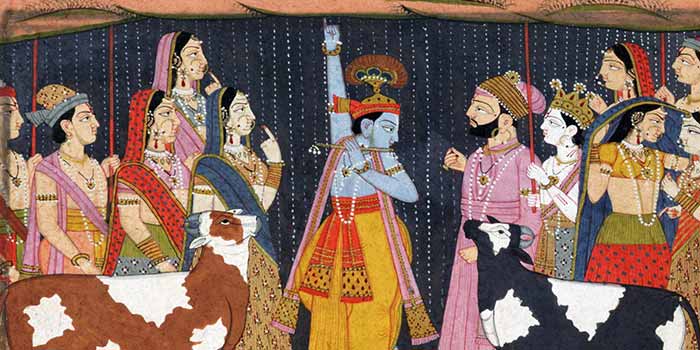
Hinduism is the oldest major religion today with a following of nearly a billion people.It had no single founder and managed to grow for over 4000 years in syncretism with other religions. It is also called the Sanatan Dharama (Eternal Religion)
Hinduism originated as a synthesis of the religion brought by the Aryans and the indigenous religion (c.1500 BC).Historians can trace its origin to 2200 BCE, when the Indo-European tribes invaded N. India and brought their 'Vedic' religion along,which later mingled with native Indian culture, " Indus Valley Culture".
Central doctrine of Hinduism is reincarnation (transmigration of the soul), or continuing cycle of birth and rebirth called Samsara. Accumulated sum of ones deeds called Karma determines next life.
Four goals of Hindu life are kama, artha, dharma and moksha. Humans seek kama (emotional or physical pleasures) and artha (power) but can only harmonise it in a higher, framework of dharma. Hinduism is a Henotheistic religion which chiefly recognises a single diety but also recognises other gods and goddesses as a manifestation of the Supreme God. Sacred primary texts of the Hindus are the Holy Bhagvad Gita,Mahabharata & Ramayana, and the four Vedas which describes basic Hindu philosophy.
Hinduism is not only an intellectual breed of philosophy but also an approach or a way of living in this universe. Therefore, Hindu religion is more than a matter of practice than believe for many Hindus.
Though Hinduism is full of festivals and fasts, all events, major or minor have a deep meaning attached. Traditionally, Hindu festivals are also celebrated and observed in diverse modes reflecting the very richness of its culture. Major Hindu festivals include Maha Shiva Ratri, Holi, Dussehra, Rama Navami, Raksha Bandhana, Janmashtami, Navaratri, Diwali/ Lakshmi Puja etc. and various other numerous festivals.