
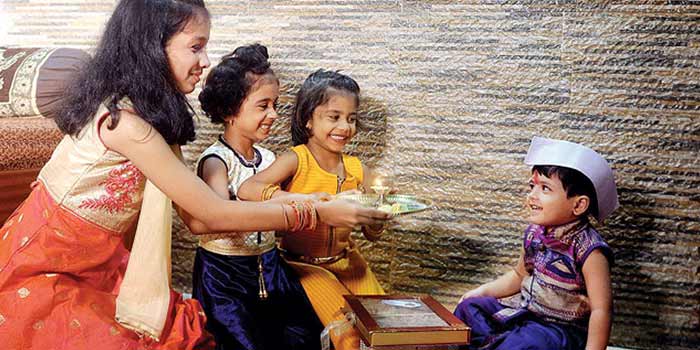
Bhai Dooj is celebrated in India to honor one of the most precious and special relationship between a brother and a sister. The occasion of Bhai Dooj is followed mainly by the Hindus and is an important occasion to glorify the relationship of a brother and a sister. On this day a girl prays for the well-being and prosperity of her brother and puts a vermilion (also called a Tilak) on the forehead of her brother. The brother in turn vows to protect his sister at all times and also showers his sister with gifts. This is a special festival on the Hindu calendar which reaffirms the strong bond between a brother and a sister.
There are many interpretations of the Bhai Dooj festival which also goes by the name of Bhaubeej (in Maharashtra), Bhai Bheej (in Gujarat) and Bhai Pota (in West Bengal). Be it any region or any name this festival invokes huge excitement amongst the Hindus. New clothes, tempting dishes, gifts and sweets are all part of the customs associated with the Bhai Dooj festival. Bhai Dooj festival is celebrated every year and is one true celebration of a relationship. Every year the festival of Bhai Dooj falls during the month of October and November.
THE NAME of Bhai Dooj refers to two terms namely Bhai that means Brother and Dooj that stands for the second day after the new moon. Bhai Duj is celebrated every year usually in the month of October-November, two days after Diwali festival.
2018 Bhai Dooj Festival on 9 November.
"Bhratus tabaa grajaataaham, Bhunksa bhaktamidam shuvam Preetaye yama raajasya, Yamunaah Visheshatah."
" I'm your sister, Eat this sacred rice, For the pleasure of "Yam Raj" and "Yamuna"."
The auspicious occasion of Bhai Dooj is eagerly awaited, that reinforces the bond between brothers and sisters and their affectionate relationship. On the festive day everyone gets ready very early to celebrate the Occasions. After praying to God, the sisters perform the aarti of their brothers and put 'tika' and 'chawal' on their forehead, praying for their well being and brothers in return pledges to take care of her, in any condition. It's an opportunity for a good feast, coupled with an enthusiastic exchange of gifts, and merriment in every Indian household.
According to the Hindu scriptures say: "A forehead without a Tilak is worthy of condemnation and they exist for name's sake only." It is held that anyone who receives the auspicious tilak on the forehead from his sister on this day would never be hurled into hell.
Bhai Dooj is celebrated two days after the grand celebrations of Diwali festival. The festival of Bhaiya Dooj is observed among Hindus throughout India with great devotion and known with various names such as : 'Bhav-Bij' in Maharashtra, 'Bhai Phota' in West Bengal, 'Bhai Beej' in Gujarat. Bhathru Dwithiya, Bhai-Tika, Bhatri Ditya and Yamadwitheya are some other popular names for Bhai Dooj.
Bhai Dooj celebrations include many popular dishes which add up to the excitement of the occasion. A sister leaves no stone unturned in making a memorable Bhai Dooj for her brother by preparing delicious sweet dishes on the occasion of Bhai Dooj. Popular sweet dishes prepared on the day of Bhai Dooj include the Kaju Burfi, Moong Dal ka Halwa, Rasgulla, Malpua, Pista Sandesh and Kesar Burfi
BHAI DOOJ is also celebrated as 'Yama Dwiteeya'. It's believed that on this day, Yamaraj, the Lord of Death and the Custodian of Hell, visited his sister Yami's house, who put the auspicious mark on his forehead praying for his safety and prosperity. So on this day Sisters apply tilak on the forehead of their brothers and seeks God's blessings for them. Therefore this festival represents respect, love and admiration of sisters towards their brothers.
ACCORDING TO one legend, on this day, Lord Krishna, after slaying the Narakasura demon, goes to his sister Subhadra who welcomes him with the lamp, flowers and sweets, and puts the holy protective spot on her brother's forehead.
YET ANOTHER story behind the origin of Bhai Dooj Festival says that when Mahavir, the founder of Jainism, attained nirvana, his brother King Nandivardhan was distressed because he missed him and was comforted by his sister Sudarshana. Since then, women have been revered during Bhai Dooj Festival.
LIKE OTHER festivals in India, Bhai Dooj is also an Occasions for family get togethers, feasting and exchanging gifts. Bhai Dooj is also a celebration of sacred relationship between sisters and brothers. Although this festival is dedicated to the bond of care and affection between brother & sister but it goes way beyond it. Bhaiya Dooj signifies the peaceful co-existence of every individual, promotes the feeling of unity and encourage the harmonious social life. .
Bhai Dooj Festival : Get complete information about Bhai Dooj Festival and its celebration.
Bhai Dooj : A complete source of information about Bhai Duj celebrations, legends and significance.