
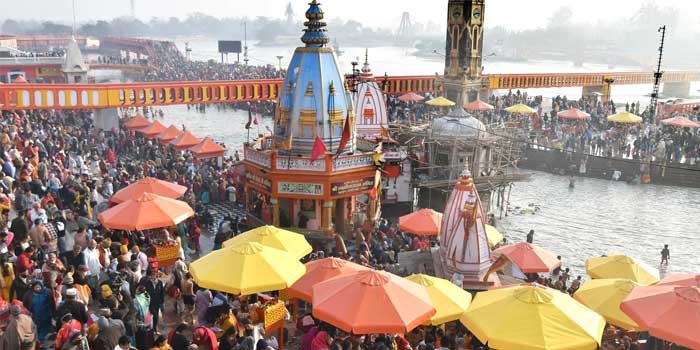
The holy festival of Kumbh is the most sacred celebration for Hindus. The festival falls every 3 years and is celebrated in 4 different cities, viz., Allahabad, Hardwar, Ujjain and Nasik. The Kumbh Mela at Allahabad is said to be the Maha Kumbh Mela. The site for the mela in Allahabad is the famous Triveni Sangam, which is a confluence of the holy rivers Ganga, Yamuna and invisible Saraswati. It is said that if somene takes a bath in the confluence on the holy days of festival, the person gets free from the birth-cycle.
As per the Hindu mythology, history of Kumbh Mela dates back to origin of the universe. It is said that once the all the gods were under a curse and felt very tired and exhausted. Lord Brahma, the creator of universe, adviced them to drink Amrita, a drink which prevents aging and ensures a never ending life. Amrita was stored in an ocean, and could only be dug out by churning the ocean. It was a rigorous task to churn the ocean, so god decided to include the demons in the process. They falsely promised demons to share the Amrita. A mountain, Meru, was used as churning stick. Mythical snake, Vasuki was used as rope to move the mountain.
Finally the churning process got started and continued for long. Lord Vishnu had to interrupt to stop the procedure, as it was getting too late. As soon as it stopped, many mythological things came out of the ocean, which included Laksmi the Goddess of Prosperity and Wealth, Sura the Goddess of Wine, Chandra, or the moon, Apsaras, the celestial nymphs, Kaustabha, the precious gem of Vishnu, Uchchaishravas, the divine horse, Parijata, the wishing coral tree, Kamdhenu, the wish-fulfilling Divine Cow, Airavata, the four-tusked white elephant, Panchajanya, or the conch, Sharanga, the invincible bow, and Dhanvantri, Nimi and Bharadwaj - the physicians and surgeons. The Amrita also came out and gods took it and ran away. The demons chased them and a small fight also took place. During all this event, some amount of Amrita dropped out of the vessel and fell in Allahabad, Hardwar, Ujjain and Nasik. Since then, it has become a ritual to bath here and absorb the Amrita.
The festival is religiously most important for the Hindus. At every Kumbh occassion, millions of Hindus take part in the celebrations. During 2001 Kumbh at Allahabad, more than 35 million devoteed gathered at the site. Saints, priests, and yogis from all corners of India, gather to participate in Kumbh. Of all the places, Allahabad is the most sacred place and is the site for the Maha Kumbh Mela (The Grand Kumbh Fair).
The festival is visited by the most amazing saints from all across India. The Naga Sadhus are one such, who never any cloth and are smeared in ash. They have long matted hairs and are not at all affected by the extremes of heat and cold. Then there are the Urdhwavahurs, who believe in putting the body through severe austerities. There are the Parivajakas, who have taken a vow of silence and go about tinkling little bells to get people out of their way. The Shirshasins stand all 24 hours and meditate for hours standing on their heads. Spending the entire month of Kumbh on the banks of Ganga, meditating, performing rituals and bathing thrice a day, are the Kalpvasis.
It is believed that bathing during Kumbh cures the bather of all sins and evils and grants the bather, salvation. It is also believed that at the time of Kumbh Yog, the water of Sangam (confluence of rivers at Allahabad) is charged with positive healing effects and that water at the time of Kumbh is charged positively by enhanced electromagnetic radiations of the Sun, Moon and the Jupiter, the flux of which also varies in accordance to positions and the phases of the moon, and also by the + and - signs of the sun spots. As per Puranas (Hindu Scripts) properties of river water at Allahabad has been referred to as Amrit or elexir.
The Maha Kumbh mela takes place every 12 year at Allahabad, next due in 2025. The festival lasts for more than 1 month. During this period, the city witness arrival and departure of more than 30 million pilgrims. The most auspicious day for the holy dip is the day of the revered saint Amavasya, when the banks of the Sangam are flooded with devotees to as far as the eyes can behold. Other sacred days marked by celebrations are Makar Sankranti, Magi Poornima, Paush Poornima, Basant Panchmi, and Maha Shivratri. (Hindus consider the period when the sun enters the zodiac known as Makar or Capricorn as most auspicious and beneficial, and rejoice and pray on the day of Makar Sankranti.