
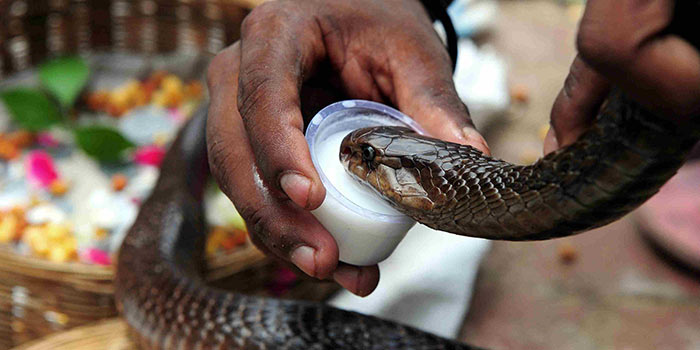
Naag Panchami or festival of snakes is a unique festival dedicated to honour the Serpent God or Naag Devta. Falling on the fifth day of Shravan in July/August, reverence for the cobra (snakes) are paid.
Fairly widespread before the Aryan invasion, worshipping of snakes or Naga was later incorporated into Hinduism by the Aryan themselves. Hindu Mythological books are famously filled with stories, fables and pictures of snakes.
Lord Vishnu's couch is the green, thousand-headed snake (Ananta or Sesha) who could hold up the earth. Lord Shiva wears a snake for ornamental purpose. Even Lord Krishna is called "Kaliya Mardan" to commemorate his victory over the giant snake, Kaliya.
A farmer while tilling his land incidentally killed some young serpents. The serpent took revenge by biting all members of the farmer's family except his daughter, who worshipped snakes.This devotional act of the girl resulted in revival of her family. So on the day of Naag Panchami, tilling of land is forbidden. Snake worship is however believed to have originated due to man's natural fear of reptiles.
One of the oldest and auspicious festivals, women fast on this day. Also, women draw pictures and images of snakes on walls of their houses with a mixture of cowdung, milk and black powder. Offerings of milk, ghee, sweets, water and rice are also made at the sites of snake holes. Devotees consider themselves lucky if snakes drink offered milks. Naag panchami is observed and celebrated in different ways in various parts of India.
It is mainly observed in Southern India, Maharashtra and Bengal. In Jodhpur, huge cloth effigies of the serpents are displayed at major fairs. Also in W.Bengal and parts of Assam and Orissa, the snake deity worshipped on Naga Panchami is the goddess Manasa. In Kerala, huge crowds throng snake temples on this day to worship stone or metal icons of the cosmic serpent Ananta or Sesha.