
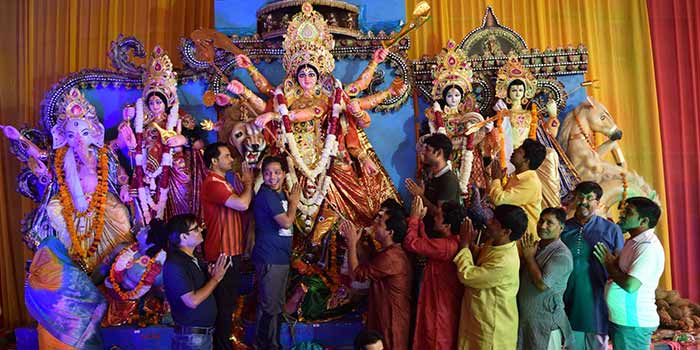
Durga Puja is an important Hindu festival which is marked by worshipping Goddess Durga during a period lasting 9 days. Celebrations of Durga Puja are visible throughout the country especially in the state of West Bengal where the festivities take gigantic proportions. Many pandals (makeshift structures) are decorated during the Durga Puja festival in honour of Goddess Durga. Fasting, festival dishes, devotional songs, decorations are some of the main aspects of the Durga Puja festivals.
Durga Puja is a festival which epitomises the victory of Good over Evil. Today, the festivities associated with Durga Puja can best be enjoyed at the various Durga Puja pandals which come up across the country. These pandals play various music and devotional songs in honour of Goddess Durga and are aesthetically decorated to provide for an ideal setting to offer prayers to Goddess Durga.
Durga Puja festival is known and celebrated with different names in various parts of India. In Bengal, Durga Pooja is also known as Akalbodhan (untimely awakening of Durga), Durgotsab (festival of Durga), Maayer Pujo (worship of the Mother). Durga Puja festival is also called Navratri Puja in Gujarat, Maharashtra, Delhi. It is celebrated as Kullu Dussehra in Kullu Valley, Himachal Pradesh.
Durga Pooja is celebrated twice a year, once in the month of Chaitra (April-May) and then in Ashwin (September-October). On both Occasions nine different forms of Goddess Durga is worshipped threfore called Durga Navratri (nine nights). According to the Hindu Calendar Durga Pooja festival starts on the first day and ends on tenth day of bright half (Shukla Paksha) of Ashwin month.
Durga pooja is celebrated extensively all over India but West Bengal, Assam, Jharkhand, Orissa, Bihar are the states where beautiful idols of the Mother Goddess are worshipped in elaborate pandals, durga temples for nine days, and on the tenth day, these are carried out in procession for visarjan (immersion) in a river or pond.
The festivities start with the first day called Mahalaya. It is also the day of the beginning of the countdown to the Durga Puja. The face of the goddess remains covered until the bodhon (unveiling) ritual is performed on Sasthi - the sixth day of the moon. Fast is observed on this day by women for the well being of their families.
The Goddess is worshipped as a kumari or young girl, and reveals herself in her true form Mahasaptami (the seventh day of the moon). On Mahastami (eighth day) and Mahanavami (ninth day) the celebrations reach a fever pitch. New shining clothes, smiling faces, dancing devotees, chantings of Mantras, spectacular display of lights and the rhythmic beat of dhak (drums) adds excitement to the festive Occasions. On Vijay Dashami (tenth day) the idol of Durga is immersed in water after performing customary rituals. The ten-armed goddess dazzles the devotees with her splendour and appearance of fiery valour during her short stay every year.
The 10 day Durga Pooja festivities are celebrated with lot of fanfare and excitement. Popular dishes are prepared during the Durga pooja celebrations which spice up the festive mood of the people. Recipes for popular dishes prepared during the Durga Pooja celebrations can be found on our Recipes section. Some of the noteworthy mentions include popular dishes like: Rasgulla, Sondesh, Mishti Doi and Luchi. You can get many more exciting recipes on our Recipes section which can be tried out during any occasion. We have a vast collection of exciting Indian recipes which are well-categorised for easier navigation.
Durga is an incarnation of power the resides in every element of this universe. The literary meaning of Durga is difficult to approach. Being Durga, Goddess Durga is the embodiment of intelligence, power, wealth, beauty and mercy that is creator, preserver and destroyer of this universe.
During Durga Puja festival, nine different forms of Goddess Durga is worshipped. The whole image of ten-headed and multi-armed mother goddess riding on a Lion is shown destroying buffalo-demon Mahishasura. This image signifies the victory of Good over Evil and also tells to invoke divinity by controlling the senses to get diverted to bad habits.
Durga Pooja festival is a celebration of life and its traditional and valuable culture.
According to a Puranic legend attached to this day, demon Mahishasur vanquished the gods and their king, Indra, who approached the Holy Trinity, Brahma, Vishnu and Shiva. They in turn sought the help of the divine mother Durga who, equipped with lethal weapons, riding a ferocious lion, in all her awesome majesty, killed Mahishasur. This day, thus, also celebrates the magnificence and omnipotence of Goddess Durga.
The festival of Durga Pooja has its link with Pandavas. According to the great Indian epic the Mahabharat, the Pandavas had to spend 12 years wandering in the forest and one year in camouflaged form. The Pandavas spent their last year in the court of Virat. On the end of one year Pandavas regained their arms from the shammi tree and declared their true identification. It was the day of Vijay Dashmi. Since that day the exchange of Shami leaves has become the symbol glory and triumph.
1st day - Kalasha Sthapana - Shailaputri Puja
2nd day - Preeti Dwitiya - Brahmacharini Puja
3rd day - Chandrakanta pooja or Chandraghanta puja
4th day - Kushmanda pooja
5th day - Skandamata Puja - Lalitha Panchami
6th day - Katyayani Puja - Maha Shashti or Durga Shashti
7th day - Kaalratri Pooja - Durga Saptami or Maha Sapthami
8th day - Maha Gauri Pooja - (Durgashtami Puja/Maha Ashtami/Veerashtami)
9th day - Siddhidatri Puja - (Mahanavami/Maharnavami or Durga Navami)
10th day - Vijaya Dashami or Dussehra