
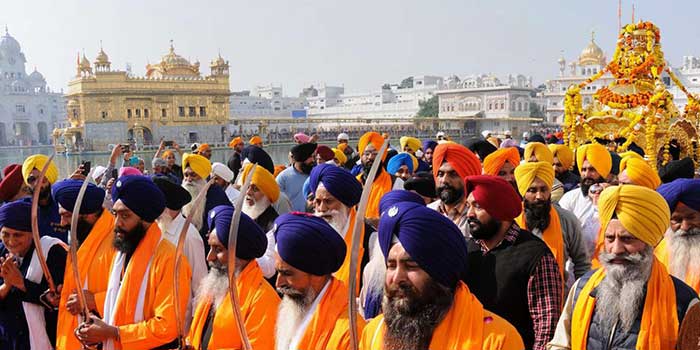
Also known as ' Guru Nanak Jayanti ', it is the birth anniversary of Guru Nanak who founded the Sikh faith. For two days and nights preceding the festival, the 'Granth Sahib' (Holy Book) is read and on the day of the festival, taken out in a grand procession. Guru Nanak Dev, the founder of the Sikh faith, was born in the month of Kartik (October / November) and his birthday is known as Guru Nanak Jayanti. He was born in 1469 A.D. at Tolevandi some 30 miles from Lahore. The anniversaries of Sikh Guru's are known as Gurpurabs and are celebrated with devotion and dedication.
He was not only the founder of the Sikh religion, he was a great poet, philosopher, humanist and a powerful social reformer, a teacher of mankind. Nanak said that one need not become a sanyasi sacrificing one's family, to please God. Those who practice devotion, whose mind is pure and who have sympathy, patience and honesty, are in no way inferior to a sanyasi . He considered that all human beings were high-born; no one was low. He stressed, "Do not ask someone's caste; those whose devotion is accepted by God are good people. God appreciates those who have conquered the 'I' and 'greed'. Nanak washes the feet of those who concentrate their minds on God, the source of truth".
The akhand path or the continuous reading of Granth Saheb, the sacred book of the Sikhs, begins three days before Guru Nanak Jayanti. The sacred scripture is read non-stop from beginning to end. The Akhand Path culminates on the day of the Guru Purab and the holy book is then taken out in a procession. It is beautifully decorated with flowers and carried on a float. Children participate in the procession and march to the tune of local band playing religious hymns. The procession is led by five armed guards who are called the panj pyare. At the head of the procession is the Nishan Saheb or the Sikh flag.
A few days before Guru Purab, people take out Prabhat Pheris or the early morning processions from the Gurdwaras. They go around their locality singing shabd or the religious hymns.
Later in the day, special kirtans are arranged in the Gurdwaras. The devotees attend langar or the common meals where everyone eats the same food irrespective of caste, class, or creed. Devotees offer their services for cooking food, cleaning the Gurdwara or carrying out other chores. This is called the Kar Seva.
In the evening, the Gurdwaras are illuminated and people visit them in large numbers. People also illuminate their homes with candles and earthen lamps.