
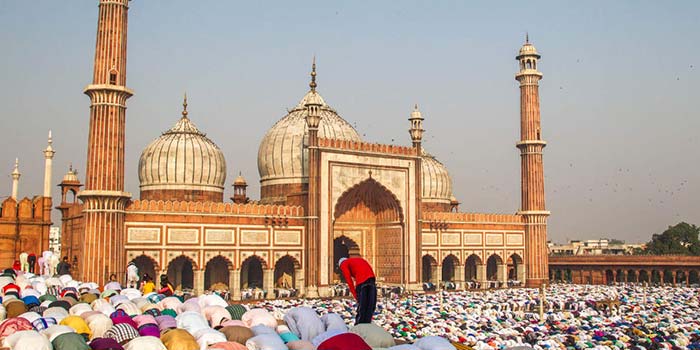
The festival of Eid-e-Miladulnabi is also popularly known as Barah Wafat the twelfth day. The day commemorates the birth and also the death of Prophet Mohammed. Bara Wafat falls on the twelfth day of the third month Rabi-ul-Awwal in September/October. Here, Barah or twelve, stands for the twelve days of the Prophets sickness.
The celebrations of birthday are subdued as the day also happens to be the death anniversary of Prophet Muhammad. The day is marked by holding religious discourses, reading the Holy book of Quran and giving alms to the poor.
Eid-ul-Milad festival was celebrated on 13th January 2014 (Tuesday) by Sunni Committee. and 18th February 2014 (Sunday) by Shia Committee.
Prophet Mohammed was born in 571 A.D on April12th, in Mecca in Arabia. Circa 610 AD, Prophet is said to have gained revelations from Allah through the angel Gabriel that he was His Messenger. In 622 AD Mohammed along with his followers went to Medina.
This flight from Mecca to Medina is known as Hijrah and marks the beginning of the Islamic era. By 630 AD, Islam came to be accepted as a religion and Muhammad as ruler by a large number of people. However, in 632 A.D. Muhammad led the pilgrimage to Mecca, preached his farewell sermon and died soon after.
Islam is strictly wedded to monotheism. Allah is the only God and has no partners. Worships directed at saints, prophets and other human beings are considered idolatry. Islamic doctrines are based on 4 fundamental principles or Usul; Quran or Koran, Sunnah (Traditions), Ijma (consensus) and Ijtihad (Individual thought).
Barah Wafat does not call for any kind of grand celebrations as the birth day and death anniversary of Prophet Mohammed coincidently falls on the same day. Hence, Muslims spend this period in spiritual activities. Special prayers meets and discourses on Quran are also organised in mosques to mark the day of Milad.
Learned men and scholars focus their sermons on the life and teachings of Prophet Mohammed and inspire people to follow the path of good life as shown in Quran. Hence, the festival gives a chance to people to introspect their deeds and think of ways of being a better person.
Besides, in some places hymns are sung and elegies or marsiyas are recited in memory of the last days of the Prophet. Acts of charity are also done by devout Muslims and alms are distributed to the poor and the needy. Later, people invite friends and relatives for a feast.
In some mosques, however, a sandal rite ceremony is performed over the symbolic foot prints of the Prophet engraved in a stone. A stone imitation of buraq the horse on which Prophet Mohammed is said to have ascended to his heavenly abode is placed near the foot prints and anointed with sandal paste or scented powder. Besides, the house and casket containing this are elaborately decorated.