
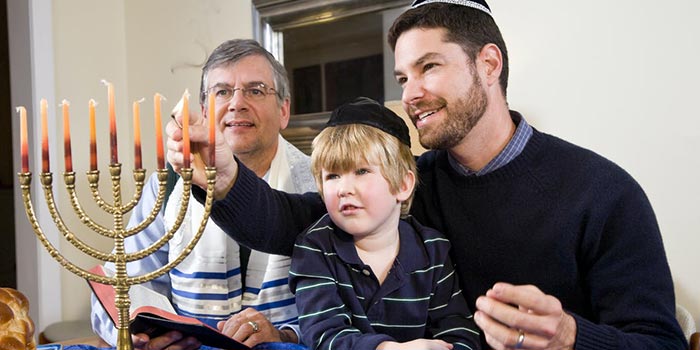
Chanukah is commonly known as Hanukkah. Chanukah festival is the Jewish festival of rededication. It is popularly called as the 'festival of lights.' It is an eight day festival beginning on the 25th day of the Jewish month of Kislev. The next chanukah falls on November 27th to 5th December , 2013 (Jewish Year 5766).
Chanukah is one of the best known Jewish Festivals but not of very great religious significance. The holiday's religious significance is far less than that of other Jewish festivals. It is not mentioned in Jewish scripture; the story is only related in the book of Maccabbees not accepted as a scripture by the Jews.
As recorded in the Talmud, at the time of the rededication of the Jewish Temple, very little oil left was left that had not been defiled by the Greeks. Oil was needed to burn the menorah (candelabrum) every night in the Temple. It was just enough to burn for a day, yet miraculously, it burned for eight days. To commemorate this miracle, Jews light a Menorah for a period of 8 days during Chanukah.
An eight-branched candlestand or menorah used is a frequent symbol for celebrating Chanukah. Chanukah candles are for pleasure only and not for any productive purpose. On the first night, a candle is burnt throughout the night and second on the second night and so on.
On the ocassion of Chanukah, it is traditional to eat fried foods because of the significance of oil. Gift-giving is not a traditional part of the holiday, but has been added in some places.
Many Jews and non-Jews think of this holiday as the Jewish Christmas, adopting many of the Christmas customs, such as elaborate gift-giving and decoration.
A traditional song of this holiday is "Maoz Tzur," better known to Christians as "Rock of Ages".