
Shauvot is originally a festival celebrating summer harvest but soon linked to the giving of the law to Moses on Mount Sinai. Jews look upon the Torah as God's greatest gift to them. During the original festival all the farmers would bring their first fruits to the temple, where they offered them as a sign of their thankfulness to God.
Today, Shauvot is much more important than the link with the harvest. It is linked with Mount Sinai where a group of ex-slaves was changed into a nation. The whole basis of Judaism are the laws that Moses received at Mount Sinai. There were 613 laws given to Moses, but the most important and the most well known are the 10 commandments.
Traditionally Jews stay up on the night of the Shauvot reading the "Torah" and eating sweet cakes to remind the Jews that the Torah is sweet to the spiritual taste.Jews also read the book of Ruth on Shauvot a beautiful love story very appropriate for this particular festival.Shauvot is also known as the 'festival of first fruits'.
In ancient Israel, three 'pilgrimage' festivals drew the scattered Jews to the temple in Jerusalem. Sukkot, the autumn festival also celebrates the years that the Jews spent wondering in the wilderness. Sukkot with Shauvot and Pesach sums up the complete story of the Exodus until the return to the promised land.
Sukkot begins five days after Yom Kippur and spans for another seven days. Many families live in a tent to remind 'their nation had no permanent home'. "Sukkot" means tent or temporary shelter. Sukkot also reminds Jews about the fragileness of life and dependence upon God. It is symbolised by having a hole in the roof of the Sukkot to always reamin open with God.
On the fifteenth day of this seventh month is the feast of Booths for seven days unto the Lord. On the first day is an assembly to the Lord and you shall do no work. On the eight day is also an assembly to the Lord and you shall do no work'. (Leviticus 23 : 34-36)
Festival of Simhat Torah takes place immediately at the end of the festival of Sukkot. On this day, annual cycle of readings from the Torah ends and a new cycle begins. The last reading of 'Torah' are on Deuteronomy and Genesis to show that the Torah has no beginning and no end, but is eternal.
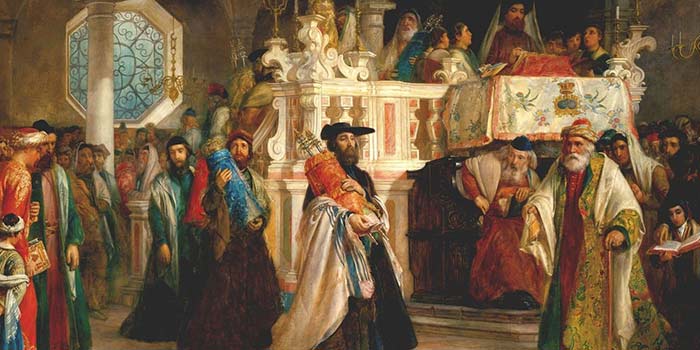
During the service the scrolls of the Torah will be carried around the synagogue, and sometimes into the surrounding streets, accompanied by great rejoicing and happiness. Children kiss the scrolls, carry banners and receive sweets